Showing posts with label leprosy. Show all posts

Saturday, January 27, 2024

King Oscar and the lighthouse


If you've lived around the Puget Sound for any length of time, you know about The Gray.

The Gray - where you can't tell the sky from the water.
It has other names, of course. The Gloomy Season. The Big Dark. The Drizzle. Or, as they say in a particular movie, "It rains nine months of the year in Seattle." The constant overcast and light-to-heavy rainfall, combined with our location above the 45th Parallel, means that from November to March the Puget Sound skies are almost unrelentingly dark, foggy, or both. If you don't already have Seasonal Affective Disorder, you'll start to develop a touch of it in midwinter. You need to develop strategies to fight The Gray or it will overwhelm you and shut you down.

Now if this were a normal time, I'd fight The Gray by being with people. I'd visit family and friends. I'd go to Bremerton's nerd pubs and play pinball or cabinet video games. I'd strike up conversations with friendly strangers in the library. I'd gather with local geeks to play board games. I'd go to storytelling nights and hear about people's adventures from their own mouths. I'd meet people and I'd make friends.

But this is not a normal time.

I don't want to get sick. I don't want to make other people sick. I can't be successfully frugal AND spend much time with local friends, since it takes time and money to visit our old stomping grounds on the Eastside. And with a couple of rare exceptions, I haven't gotten out enough to meet any new people around here. I've been strongly isolated. And isolation is no way to fight The Gray.

What to do?

Well, if you're me, which I am, you knit and crochet while listening to back episodes of The Magnus Archives, putter around the house, cook, read library books, spend way too much time bingeing YouTube videos. And when you tire of that, you go troll hunting.

Today, since Captain Midnight was determined to DM some D&D deeds of derring-do, I was on my own for the afternoon. The Gray was lowering and unrelenting, but it was not a day to stay in. So I stole CM's jacket, gathered up the usual bundle of accoutrements (vitamins, water bottle, hot chocolatey goodness) and made for the ferry to Vashon Island.

You might not consider Vashon a prime spot to hunt for trolls, and ordinarily I'd agree with you. It's a fine place to find aging hippies, bike-eating trees, and (if rumor is correct) several ferocious local strains of cannabis, but until recently the only certain locale for Scandinavian cryptids was under the Aurora Avenue bridge in Seattle.

And then Thomas Dambo and crew came along and shook things up. But we'll get to that in a bit.

It usually takes a while to drive from our current digs to the Southworth ferry dock in Port Orchard. It usually takes even longer for the Southworth/Vashon/Fauntleroy ferry to show up -- so much so that on the rare occasions when I've used it to get back to Kitsap from Seattle, I end up waiting so long that I'd have made better time just driving around Tacoma and up the peninsula. CM and I usually refer to it as "the cursed ferry." So to my great delight, I didn't have to wait more than 10 minutes for the cursed ferry to arrive at Southworth Dock. And it didn't take another 10 minutes to make the crossing from there to Vashon.

Despite the gloominess of the day, I enjoyed my first look at Vashon Island. I couldn't live there, as there's no hospital or even a basic medical clinic, and everything has to reach the island by boat or helicopter. But it has a remarkable number of creative people per capita, and it's beautiful.

I drove merrily through the cute little downtown area, took a turn to the left and continued to follow driving directions for... far longer than I'd expected. How long should it take to reach any spot on an island of 37 square miles? As the roadway narrowed and twisted, I pulled over and sent a quick text to my siblings: "This place is in the middle of nowhere. IF I SHOULD FALL, TELL MY STORY"

Just then, though, the end hove in sight: the upper parking lot of the Point Robinson Lighthouse. 'Bout time.

Point Robinson Park sign, with birdhouses
(BTW, if you're new to troll hunting, look around for clusters of painted birdhouses like these. They're a sure sign that trolls are nearby.)

Since I'd never been to Point Robinson before, I was also curious about the lighthouse. And at the time it seemed like a lot of people were paying homage to King Oscar. So I thought I'd just pop down and see the lighthouse first.

To the lighthouse! (Isn't that a story?)

This turned out to be a mistake. Not the seeing-the-lighthouse part, the taking-this-route part. I headed down a forest trail that quickly became slick with mud and crud and slippery fallen leaves, and there were no handrails to cling to. Frankly, it's a minor miracle that I didn't slip and fall on my butt, BUT(t) somehow I SLOWLY worked my way down, walking like a little granny, and made it to the end of the path relatively unscathed (though it's a good thing my shoes were designed to be laundered).

The end of the trail and the Point Robinson lighthouse
And here's what I found!

Let's take a closer look, shall we?

Yes, come closer
Ah yes indeed, very nice. 

No tours in the off season, sadly
No official tours until Mother's Day, more's the pity. But we're good at showing ourselves around the place.

After taking a few more attractive foties...

The lighthouse from its "good side"

And from its not so good side

I don't have a good side.
...I decided to head back. Though by this time I'd figured out there was another route up to the parking lot, so I didn't have to run the mud gauntlet again. Which is good, because I don't think my shoes could've taken it.

TROLL sign
Lessee, what was I doing here again? Oh yeah.

King Oscar's courtyard
In a circular clearing not too far away... there was King Oscar holding court, surrounded by birdhouse clusters on poles. And a lot of fans.

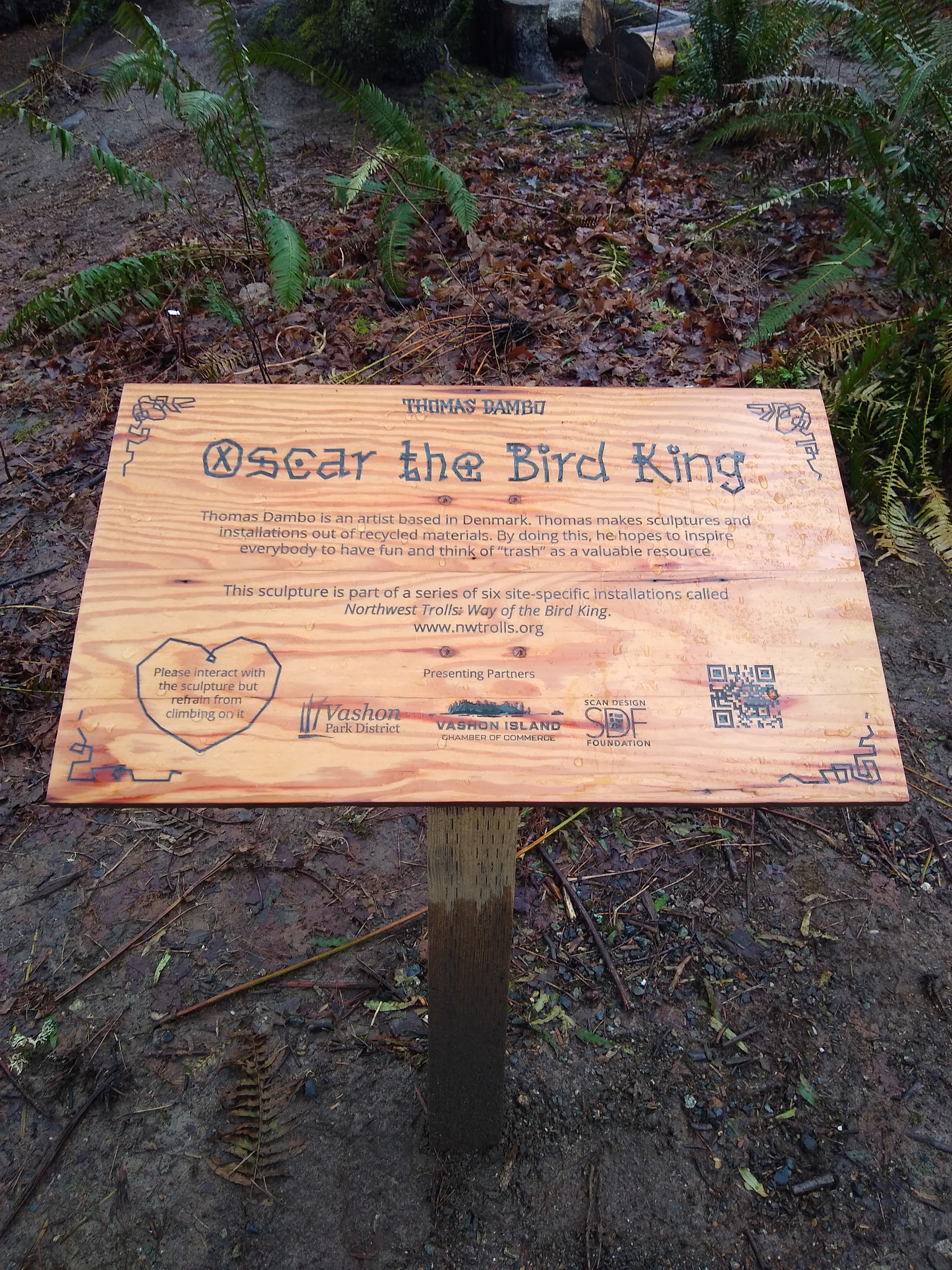
A helpful plaque
If you're curious to know more about him, there's a helpful plaque nearby that goes into more detail about Oscar and about Thomas Dambo, the Danish artist who created him (and other trolls) out of local scrap wood.

The man... well, troll... himself!
Like most wise rulers, Oscar's staying off his feet today.

King Oscar's face up close
He looks so much more handsome in person than he does on the sardine cans. Also I like his birdhouse crown. Very chic.

Oscar gots pedicure game!
Someone had used a few local clams to give him a fabulous pedicure. As you do.

Do NOT pull his finger.
I handed my phone to an innocent bystander and proceeded to commune with the King.

Soozcat and King Oscar
Now we're officially BFFs. If you can't be a king, it's at least nice to know one.

I wasn't through exploring yet, though.

What is this thing? I DO NOT KNOW.
Not far from the King's court was this mysterious object.

Kinda cool looking... thingy.
Other than possibly being some kind of cryptic municipal art, I have no idea what it was.

Mysteeeerious.
If you know, do clue me in, won't you? I'm most curious.

HERP DERP
And then I ran off and took goofy selfies in front of a mural because I could.

Anyway, that's one way to fight The Gray. And it worked pretty well if I do say so myself!

Thursday, February 23, 2023

Notes from the Oak Table Cafe

T
HERE'S a place in Silverdale at the top of a hill, overlooking the valley and Dyes Inlet, called the Oak Table Cafe. It serves only breakfast and lunch, and it usually has a long wait time because the food is fantastic. Anyway, since my brother was in town and since we were all hungry, we went to Oak Table for some delicious brunch (if you're interested, I had the eggs Casey; Captain Midnight and Tim-my-brother opted for corned beef hash).

It had been a very long time since I entered the dining area of a restaurant; I've been very careful during the pandemic to stay masked in public and not to linger too close to strangers for very long. Looking around the room, I noticed literally no one in the very busy dining area was wearing masks or social distancing, which gave me the willies.

When CM and I first moved to Seattle, I learned some history about the city. In 1889, there was a huge fire that destroyed practically all of the central business district. After the ashes and rubble were cleared away, the city fathers urged business leaders to build back higher than the shoreline so there would be less trouble with flooding and sewage issues (the tides had a tendency to back up all the city's toilets), but as soon as they could, people began rebuilding right back on the flat again. Nothing would convince them to work in the best interest of all Seattleites; they wanted to get back to making money immediately.

At the time I couldn't understand why so many people would act in such a short-sighted fashion. But now I get it. All these places across the United States are reopening without Corsi-Rosenthal boxes or any other kind of viral mitigation measures, as the Covid pandemic continues and as we prepare for a potential H5N1 pandemic. No one will take even basic measures to guard against more people falling ill. Because it's been a few very lean years and damn it, they want their money.

It makes me wonder whether cities that want serious viral mitigation should do what the city of Seattle did to fix their problem. Since they couldn't force shop owners to rebuild higher than their original storefronts, they chose to rebuild the infrastructure--namely, the streets--twelve feet above the front doors of the new shops, requiring pedestrians to use ladders to cross the streets. This situation was so awkward that it soon became evident to shop owners that they had better do what the city government had asked for in the first place. Maybe, if you couldn't reopen your business without several Corsi-Rosenthal boxes in place and running, you would do what you needed to do to get back to serving customers. Because clearly, most people aren't going to do what's right unless it's making them money, they're being legally dragged to it, or they're shamed into doing it.

Wednesday, July 13, 2022

AAAAAH WHYYYYYYY

S

OME of you might know that I save correspondence -- the snailmail letters and postcards that I receive from family and friends. (Not ALL of them, mind you, but the ones I hold dear for one reason or another.) And several years back I got the brilliant idea to organize all that correspondence into a few binders -- one for letters and cards, one for postcards, one for the Wish I Were Here project. And it was a great idea and worked beautifully and everything was nice and neat.

For a while, anyway.

But, as with so many of the projects I begin with the best of intentions, I neglected it. And the correspondence went into a pile -- because I'd sort it out eventually, right? -- and the pile grew, and grew, and grew, and GREW as I continued to ignore it because I just knew it would be a Task of Eternity and I didn't want to devote loads of time to doing it.

Well, today I finally decided to take the bull by the horns and sort through the mighty pile. We're preparing to move and I knew I couldn't afford to wait many more days before it had to be done. I blocked off the entire day to accomplish this task, hoisted the pile onto the table, found the binders and started sorting.

It took an hour.

The task that has been hanging over my head for nearly a decade. Took. One. HOUR.

This is a prime example of ADD's tendency to play tricks with mental time estimates. I often assume that some "quick" task will take five minutes when it's really going to be more like half an hour, and I tend to avoid other tasks for long stretches because they seem like they'll be arduous and take all day, when in reality ONE FREAKING HOUR.

Welp.

On to the next task. Cleaning the bathroom. Shouldn't take more than 10 minutes tops, right?

Sunday, November 15, 2020

Pandemic: ugh

How's this past week been for the Laundry Faerie, you ask?

Public domain Cyclone image by Mark Houtzager

Well, to sum up: it's been a roller-coaster. First elated. Then nervous. Then terrified that this nation will experience a full-on coup d'état, with the tacit approval of about a third of the population. Plus, this last week -- due either to nerves or some kind of brand-new food allergy -- I've been continually breaking out in hives. 2020, you truly are the gift that keeps on giving. I had a televisit with the doctor, who prescribed an anti-steroid medication, loratadine and an antacid, but the thing that's kept me out of continual scratchy hell is Benadryl. Trouble is, Benadryl completely knocks me out. So I can either be awake and blazingly itchy from the back of my scalp all the way down to my knees, or I can have some temporary relief and stay zonked out in bed all day long.

Let's just say this week hasn't been very productive.

Fortunately, Captain Midnight came to my aid on days when I couldn't leave the house, picking up aforementioned Benadryl and emergency groceries (gotta have Mountain Dew, he says), and other stellar behaviors. He's a keeper.

Miss V has been busy working at a local business, walking a lot, getting trim and making some big life choices. But since they're her life choices, not mine, I'll let her discuss them elsewhere at her discretion.

Charlie-cat is being a furry little mendicant, as usual. It's a good thing he's so cute, or we'd have turned him into gumbo by now. He's also discovered that if anyone leaves the pantry doors open, he can sneak inside and hide out in the kitty-cat clubhouse area behind the food. We have accidentally shut him in there on more than one occasion, and only found his super-secret hiding place when he started knocking stuff over in the pantry and we looked at each other and said, "PA! DID YOU HEAR THAT SUSPICIOUS THUUUD?"

At the moment our biggest challenge as a family is staying 'rona-free until we can get vaccinated... which, realistically, won't happen until spring 2021, but it's a lifeline all the same. I've been trying to avoid risk whenever I can, but I realize we've just been lucky up to this point -- it's very easy to catch, and it's extremely difficult to tell who has it. I've got five siblings, and at this writing three out of the six of us have caught a case of the stuff. Soooooooooooooo that's fun.

I miss my mom. But I guess that goes without saying. I try to focus on the memories of her love for me; she and Dad always made sure we knew we were loved, and I'll need that knowledge to sustain me for the rest of my life.

Tuesday, October 27, 2020

Pandemic: lies, damned lies, and...

There are three kinds of lies: lies, damned lies, and statistics.
--Mark Twain, who mistakenly attributed this quote to Benjamin Disraeli

Lately I've been struggling with the way American deaths from the pandemic are being reported in the USA -- specifically, the not very subtle way certain groups are trying to spin them. Inevitably, people who want to downplay the damage being done by the spread of COVID-19 (and the numbers of people who have died from it) express the total number of dead as a very small percentage of those who become ill -- or worse, as an even smaller percentage of the overall population of America or the world. The suggestion is that losing such a small percentage of people isn't that big a deal, and we shouldn't worry about it or blame this administration for it.

Let's set aside for the moment that getting COVID-19 is not a binary experience -- it's not just two options, death or complete recovery. Let's ignore the concerns of long-haul COVID-19 patients who are still suffering from lingering symptoms nearly a year after contracting the disease. Let's pretend we can make "herd immunity" work even though there are documented instances where people have gotten sick, recovered, then contracted another mutation of the virus and died.

Because I just want to talk about percentages. Let's talk about how percentages can be used.

Here's an interesting example: the Holocaust.

Observations

If you're about my age, you probably know quite a bit about the Holocaust. You studied it in school, read about it in books, saw documentaries or historical fiction films that discussed it in detail. You know the names of extermination camps like Dachau, Treblinka, Sobibor, Auschwitz; you know what Zyklon-B was used for; you know about the experiments and the torture; you know what murderous form Hitler's "Final Solution" took. For those of you who don't know, the most accurate estimate to date is that the Nazis systematically killed about six million Jews in the Holocaust, in an attempt to wipe them out completely as a people.

And six million seems like a lot, until you think about it as a percentage of the world's population. In 1938, before the war started in Europe, there was an estimated world population of around 2.2 billion people.

6 million out of 2.2 billion? That's just 0.27% of the population. Not even a full percentage point.

What if we add in all the other people the Nazis systematically wiped out? The Communists, the pacifists, the LGBTQ people, the Roma, the people who were caught harboring Jews in their homes, anyone the Nazis considered misfits, racially impure or socially undesirable? That's another 5 million, which adds up to 11 million dead. But even adding in the others, that still brings the Nazi death camp toll to a mere 0.5% of the world's population.

That doesn't sound so bad now, does it?

Here's the thing: there are actually people who try to justify the murderous Nazi purges of World War II by expressing those deaths as a percentage. Just like certain people are trying to justify the rising death count in the USA by expressing those deaths as percentages. The trouble is, expressing unnecessary human deaths as percentages of a total is a pretty bald attempt to pretend that real human lives are merely statistical data, that "excess deaths" are not traumatic, horrifying experiences for family and friends of those thousands of people who died alone, struggling to breathe. It's led to the callous argument that since a large percentage of people who have died to date were over 70 and had medical comorbidities -- heart disease, diabetes, obesity, asthma, cancer -- their deaths don't really count, since they were just sick old boomers who would've died anyway. (It seems wise to insert a gentle reminder here that the argument "they would've died anyway" is a very slippery slope indeed. Because if you choose to normalize death this way, it's possible to rationalize a number of truly horrific acts, since all human beings eventually die.)

When you use percentages to downplay deaths, you are suggesting that unless the percentages get to a certain arbitrary size, those deaths of real people don't really count. That it's not really a tragedy, just a statistic. That we should all shrug, pick up our tools and get back to work.

Because work sets you free, I guess.

I'm not saying you folks are Nazis or anything, but if you don't want to be tarred by association, you might not want to stand that close to Dr. Mengele.


Numbers convey
the tragic scale
even as they
render the weight
manageable.

Fifty thousand is
a horrid number
but it is still
just
a number.

If the dead were
never counted
but only
and always named
it would break us. 

--ZML, "Plague Poems"

Sunday, July 19, 2020

Pandemic: really. Take it seriously.

[I originally posted this on social media, but after a set period of time I deliberately delete posts there. This one I thought was important enough to keep.]

H
ERE'S the one thing I want you to know this week: you need to take coronavirus seriously.

SARS-CoV-2 is not a hoax. It's a real virus that has caused and is causing a real pandemic. It's sneaky, it's dangerous, it can spread through people who are asymptomatic or not yet symptomatic, it can cause strokes, blood clots that require amputation, long-term debilitating symptoms and permanent damage to the lungs, and it's unpredictably fatal.

I live near Seattle, Washington, where the coronavirus pandemic first hit hard in the United States. As such, our family and many of our neighbors take COVID-19 very seriously. The death toll in King County has been high enough that nearly everyone in this area knows somebody who has died of COVID-19.

When scientists, doctors and public health officials tell you you need to stay home, wear a mask if you must go out, wash your hands regularly and maintain appropriate social distance, they're not trying to ruin your fun, nor are they trying to be political. These are basic public health measures to avoid spreading a virus we can't yet vaccinate against, to stop making more cases of a disease we can't cure, to try to keep our hospital ICUs from being overwhelmed with desperately ill COVID-19 patients. And these officials are not trying to take your rights away. They're trying to make sure YOU STAY ALIVE to exercise those rights after the pandemic is over.

People from Seattle, from New York City, from New Orleans who have been warning the rest of the country for MONTHS about how bad this stuff can be are getting used to feeling like Cassandras. There are too many people outside the hot spots who are convinced that COVID-19 isn't real, that it's "just like the flu," that it only kills old people and the sick (and even if that were true, don't you have someone you care about who's old and/or sick?), that those of us who advocate for public health measures are "living in fear," that it's all a political stunt to steal your job and/or your freedoms.

None of these things are true.

You don't want your town to get like it was here in March and April, where we heard ambulance sirens every night. You don't want it to get like it was in New York City, where at least 18,000 people have been confirmed dead of coronavirus (there are certainly more) and many, many others are living with permanent damage from their bout with it. You don't want it to get like it was in New Orleans, where Mardi Gras was probably a super-spreading event that passed the virus all over the city. And you don't want liberal passage of the virus to allow it to adapt to its host, mutating to become ever more virulent and capable of seriously sickening or killing even more people than it does now.

We've seen what this virus can do. But there were precious few people able to spread the word to us that the pandemic was already here. You don't have to go through what we did.

The measures may be annoying, but they're not hard: Stay home if you can. Wear a mask if you can't. Keep at least 6 feet away from others. Wash your hands. Don't touch your face. Stay alive until we get a cure or vaccine.

Please. We love you.

Friday, July 10, 2020

Pandemic: inciting incidents

I posted this on social media a while back, but I keep thinking about it. There's a long history in children's literature of war, disease, natural disaster, or some other catastrophe providing inciting incidents in stories, often within the first ten pages. A few examples:
  • In The Lion, The Witch and the Wardrobe, the Pevensie siblings leave their home in London to stay at Professor Kirke's relatively safe house in the country "because of the air-raids" of World War II.
  • In The Secret Garden, Mary Lennox is sent from her home in India to the house of an uncle she's never met in England after both her parents die in a cholera epidemic.
  • In The Borrowers, the unnamed Boy who has lived in India gets rheumatic fever when he comes to England for the first time; he is sent to a great-aunt's house in the country to recover.
  • In The Wonderful Wizard of Oz, Dorothy Gale doesn't make it to the safety of the cellar in time and a huge cyclone carries her and her Kansas farmhouse away.
  • In the Tripods novels, Will Parker is about to be Capped when he hears about a society of humans resisting the alien entities that have enslaved the Earth.
  • In the Series of Unfortunate Events books, the three Baudelaire siblings are cast into -- well -- a series of unfortunate events when their parents die in a mysterious fire that burns their house to the ground.
  • In The House With a Clock in Its Walls, Lewis Barnavelt goes to live with his Uncle Jonathan after his parents die suddenly in a car accident.
I could cite more examples, because there are gobs of them. But I wonder: how many kidlit books of the next 20 years will use the COVID-19 pandemic as an inciting incident? It would definitely work as one. Kids being stuck inside, masking up to go out on necessary trips, parents being out of work or being forced to work in dangerous conditions through the pandemic, not being able to go to school or visit friends, having to jerry-rig all kinds of things to keep them working, getting sick, family members getting sick, parents or grandparents sickening or dying, etc., all sound like plot points that create the sort of change that pushes Our Heroes into action. I don't think it's a question of whether the pandemic will be used, but how often.

The Secret Garden book cover

Monday, June 01, 2020

Pandemic: The Bully

I was having a chat with my sister Julie earlier this evening and she made a comment that stuck in my head. I mentioned that I'd heard so many people nonchalantly claim COVID-19 is "just like the flu," and she responded, "Yeah, it's like the flu... if the flu were a young Arnold Schwarzenegger on steroids." ("And with 'roid rage!" I added, and we laughed.)

But the more I think about it, the more I realize that vivid mental image of Ah-nold on steroids, with full-on 'roid rage, connects to a pretty solid analogy. So here it is.

COVID-19 operates a lot like an aggressive bully. (I know a little bit about bullies, as I was a target of their ire all through grade school). It's mean, it's relentless, and it's unpredictable. Most people are afraid of the bully, even if it leaves most people alone, because the bully has a way of elbowing through the crowd to pick on folks seemingly at random: the fat kid, the guy with the inhaler, the girl with diabetes, the skinny boy who has to sit out sports because he has a bad heart. Like all bullies, it preys on the weak -- and it pummels them. Sometimes it's a single harsh blow, but sometimes the bully's targets are beaten so badly they have to recuperate in the hospital. Some receive permanent scars from the damage. And some die.

Bullies can only get away with the things they do because nobody knows who they might pick on to hurt next. The unpredictability of the bully's attacks puts people on edge, makes them nervous. They might want to help those who are targeted by bullies, but what can they do?

This is what they can do. Everyone can band together to form a physical line of defense against the bully. Maybe they can't defeat the bully this way, but they can protect the kinds of people the bully likes to hurt or kill. In the meantime, they can formulate a plan to beat up the bully so thoroughly that it can't hurt people again.

Mask up.
COVID-19 homemade face mask. Image by Olgierd Rudak.
cc-by-2.0 license as of 1 June 2020. Original image here.

This is exactly why wearing a mask in public places is so critical right now. It doesn't necessarily protect you against the bully that is COVID-19, and it's certainly not a fun activity, but it keeps the coronavirus from elbowing through crowds to pick on others. When enough people do it, the bully can't operate -- it can't spread to cause more harm. Wearing a mask is a way of saying, "We can't stop COVID-19 right now, but we can protect vulnerable people from it until we find a way to kick its butt -- through a vaccine or other treatment that stops it cold."

And what of those people who boldly declare that they'll never, ever wear a face mask?

Well, have you ever noticed that real-life bullies have their -- what shall we call them? Retinues? Entourages? Hangers-on? Toadies? -- anyway, the sniveling little jerks who laugh at whatever the bully says, who cheer on whatever the bully does, because by allying themselves with the bully they hope not to be among its victims? I think of people who don't wear masks in just that way. By focusing on their own needs first and always, by refusing to do any little thing that in the least inconveniences them, by failing to protect the weak and vulnerable among us, they have chosen to ally themselves with the bully. They help spread the scourge. They are COVID-19's toadies.

And having seen what COVID-19 can do, I frankly wouldn't give them the time of day.

Thursday, May 28, 2020

Pandemic: Robbed

20 years ago this week, Captain Midnight and I got invited to a goofy party at Rob and Marie Cummings' house in Bellevue. Rob was turning 37, so he decided to host a Monty Python-themed "Old Woman" party (watch Monty Python and the Holy Grail a few times and you'll get it) and he asked all partygoers to come dressed as their favorite characters from any Python sketch. If I remember correctly, I dressed up as the deranged chef from the Dirty Fork Sketch, and CM went as the random street flasher (with a large sign reading "BOO!" under his trenchcoat). It was just as silly and fun as you might imagine; I think everyone had a great time.

So today is Rob's 57th birthday.

He isn't here to celebrate it, though. He died last month of congestive heart failure.

As his widow, Marie, expressed it, "While he did not die directly of COVID-19, he delayed seeking medical help because of his fear of contracting it."

We didn't get to see him one last time. We didn't get to thank him for his friendship or say goodbye.

We weren't even able to attend his funeral service.

Let me put this in terms Rob might appreciate: if the coronavirus were Mr. Creosote, I'd give it a wafer-thin mint and calmly watch it explode. It needs to die, and it needs to die now.

FINIS

Friday, May 15, 2020

Pandemic: ephemera

S
OME minor odd things I've noticed regarding pandemic conditions, which may or may not be forgotten by history unless someone (say, me) writes them down:
  • Decluttering is tough right now. There's plenty of time to do it, but thanks to widespread states of depression or dysthymia there may not be much internal motivation to do it. And then there's the problem of disposing of all those unwanted but still-useful items. Due to fears of COVID-19 contamination, Goodwill and other secondhand stores aren't accepting donations right now. Unless you want to break out the bazillion Amazon boxes in the garage and start trying to sell items one by one on eBay, you're kinda hosed.
  • So. Much. Flour. With lots of free time on their hands and a strong yen for comfort food, many Americans have rediscovered baking -- which means that flour, yeast and other ingredients for baked goods have vanished from stores almost as quickly as face masks and toilet paper. (Fortunately for me, the chocolate supply is still holding up!) I'm no stranger to this activity; a few weeks ago I picked up some instant yeast online, and since then this household has feasted on homemade bread, cookies, calzones made from homemade pizza dough, and Swedish apple cake. (You know I can cook.)
  • I get tired of cooking all the time, and sometimes other family members spell me off, but every now and then nobody wants to take the responsibility and everyone's hungry. That's when we yell TO THE TACO TRUCK! and light out for Westside Park. Someone in our neighborhood cut a deal with several area food trucks, so nearly every weekday around lunchtime there's a truck parked at Westside, slingin' hash and takin' names. We've seen some familiar faces from the neighborhood while waiting in line for lunch (maintaining good social distance, of course).
  • I've noticed you can now tell where other grocery shoppers are getting their news. Most people around here wear masks. Above the face coverings, their eyes are concerned, resolute, occasionally friendly. They keep a respectful 6 feet of distance from other shoppers and apologize when they get too close. Conservative media fans, on the other hand, tend not to wear masks in public (though this will change in the coming week, as King County is making it a requirement). Their expressions range from confusion to frank disdain of their fellow shoppers with masks. They don't maintain reasonable social distance, they never apologize for coming too close, and they tend to get angry when people ask them to move away.
  • Last week I had a run-in with one of these clowns, an older man with no mask, at the grocery store. I was boxed into the produce section (another shopper was blocking the exit behind me) and I couldn't get past him safely, so I waited for him to back away and let me out. But Grampa Boomer wanted something next to me and wasn't willing to wait for it, so he got really close and started passive-aggressively coughing in my direction. I had to push past him to get away (with a single-word opinion on the status of his parentage, I'll admit), but if I had a do-over I would've gotten a closeup photo of his face. DUDE. Deliberately coughing at someone else during a pandemic is a form of assault. You are old and have lived your life, and if you want to play tiddlywinks with COVID-19 that's your call, but I have a family to take care of. How dare you put me and them in danger because you want your broccoli 5 seconds faster?
  • In the same vein, I'm continually amazed at the people who are out protesting life-saving quarantine measures for reasons I can only describe as frivolous. I'm not talking about protests due to concerns most people would recognize as valid (resuming needed medical treatments, financial assistance to get through lockdown, fear of increased domestic abuse, etc.). I'm talking about people losing it because they "need" a haircut, a manicure, a massage; they are demanding the return of summer camp and the reopening of Disney properties not because it's safe, but because they're already sick of their kids. *sigh* ... really? I know, I know, these conditions have never before happened in your lifetime. They've never happened in mine either, and I can think of hundreds of things from "normal life" that I'm missing right now and would dearly love to have back, but not at the expense of other people's lives. I don't think Patrick Henry would've been on board with milling around in front of the capitol building, yelling GIVE ME PEDICURES OR GIVE ME DEATH through a bullhorn.
  • Quarantine has been fantastic for Charlie-cat. I honestly think he's going to have some kind of feline nervous breakdown the first time all three of us humans leave the house at once. He's adored all the extra company, attention, toys and treats he's been getting for the last two months. (As I typed this, he hopped onto the computer desk, curled up next to me, leaned his head on my left arm and is now purring contentedly. D'aww, fuzzy beast.)

Thursday, April 23, 2020

Pandemic: on El Papagallo, hot sauce, Clorox and Lysol

When I was still in grade school, we had a fairly popular Mexican restaurant in town called El Papagallo, and one night it burned to the ground. Here's the gist of a conversation I remember having with my mother right around the time it happened:

Me: One of my friends at school said there was a big pot of hot sauce on the back of their stove and it got too hot and burned down the restaurant.
Mom: I don't think so, honey. I read in the newspaper that it was a grease fire.
Me: No, it was too-hot hot sauce!
Mom: I'm pretty sure the newspaper people talked to the owner of the restaurant.
Me: That doesn't make any sense. It had to be the hot sauce!

After several rounds of this my mother just sighed, said, "OK, honey," and allowed my grade-school brain to believe whatever it wanted to believe. And because she'd quit arguing, I was convinced I was right, because after all, my friend had said so and it made the most sense. What did adults know?

That same sense of rock-solid, absolutely misplaced self-confidence was on display during the President's press conference today, when he forwarded the ideas -- which he clearly felt were intelligent, well-founded and in no way insane -- that people should try to kill off a coronavirus infection by introducing bright lights into the body, and clean their lungs by injecting disinfectant. He has exactly the mindset of a stubborn grade-schooler who is convinced of his own brilliance and rightness, and no journalist, no epidemiologist, no scientist is going to tell him otherwise. It amazes me that he's gotten to this stage in life without ever getting clocked in the head by reality, but it seems money really can shield people from the consequences of their own stupidity.

Crowing rooster

The thing is, no one hung on my every word in grade school. Nobody decided Mexican restaurants were dangerous or started grassroots campaigns to shut them all down because of my personal, absolute belief that a batch of hot sauce had destroyed El Papagallo. My infantile beliefs weren't important to anyone but me, and my mother knew it, which is why she simply stopped arguing with me. But millions of Americans actually listen to, and believe in, this stubborn, unhinged moron's random rantings of the day. Somebody's going to go out and try gargling Clorox tomorrow because Trump was so convinced his homegrown hunches about COVID-19 were better than the lifetime studies of brilliant scientists working to find a cure. Somebody's going to start touting tanning beds as the cure for coronavirus. And somebody's going to die painfully because she injected herself with Lysol.

The only thing scarier than COVID-19 is realizing that the President of the United States is mentally unhinged, yet still convinced of his own competence... and that a sizable number of Americans are willing to follow anywhere he leads, even right off the precipice.

Wednesday, April 22, 2020

Pandemic: random thoughts

A handful of things you think about if you're me (which I am) and you're up late at night/early in the morning to get some much-needed solitude while in quarantine.

Pandemics create so many rapid societal changes that it's tough to keep track of everything that's happened, or to predict what may happen with any accuracy. I am trying to keep track of the things that are happening for several reasons (one of them admittedly self-serving; I have a story on the back burner about an engineered virus that rips through the world, altering people's ability to communicate with each other, and I imagine some of the things we're seeing with SARS-CoV-2 would happen in that fictional world as well... so I'm taking notes).

I think most people living through this realize they're witnessing a major historical event unfolding in real time. We understand that some day, people will study this pandemic. So if future generations ever read this rambling first-person narrative as history, here's something I want you to understand: we don't know how this is going to end. You have the benefit of hindsight, of knowing how long quarantine and self-isolation and social distancing and other viral stop-gaps had to continue, of understanding what we did to keep the millions of people suddenly out of work from being kicked out on the street to die, of being aware what antiviral treatment or series of treatments finally put the 'Rona to rest or at least in abeyance, of seeing what leadership measures needed to be taken and were not, what kind of political fallout came from all of this, how it changed society. We don't know any of those things. The future is completely opaque to us, and that's what makes this time especially wearing on the soul. We don't know how many months or years we'll have to keep our distance from fragile friends and loved ones so they won't get sick, how long we'll have to wait before it's safe to hug someone again. We don't know how the many businesses and social organizations that will inevitably fail during this pandemic will end up altering our society. We don't know which, if any, of the many experimental treatments now in the pipeline will work. We don't know who will make it out of this alive, and which people -- like my friend and KIN colleague Sarah Johnson, who died of COVID-19 on Saturday -- won't. We don't even know what insane things are slated for next month (Yellowstone eruption? coronal mass ejection? alien invasion? AAAAIIIEEE GOJIRA!?). We can't know these things any more than you can know what'll happen to you next week -- maybe less so, because I want to assume your lives are stable enough that you can plan and dream more than a week in advance. We don't have the luxury of dreaming right now; we just have to focus on not getting dead. History only seems inevitable when it's happened, not while it's happening.

In the same vein... I just want the luxury of being able to talk about ideas again, about books and movies and art and even video games. I don't want to discuss who died today, whether I need to suit up and venture out for supplies, or what I'm going to make for dinner.

H
OLLYWOOD plans ahead, but it occurs to me that in a few years, there's going to be a COVID-19-shaped hole in the movie release pipeline. I suppose anyone foolhardy enough to make a halfway decent film during the pandemic stands to make some bank. Assuming the 'Rona doesn't decimate anyone who tries, of course.

The safest bet for a pandemic project like this would probably be an animated film. Voice actors could record their parts from home studios, coached remotely by a director; individual animators could probably work safely from quarantine.

Less safe but still possible: a small, artsy film made by a team of people who were already in quarantine together -- say a husband-and-wife team or a family of actors. It would probably be best to create a quality adaptation from Shakespeare, or to adapt a novella where all the action takes place in a single location, or to create a documentary about the pandemic itself.

The most dangerous and foolhardy project, and (alas) probably the most likely to happen, is a big group of film students Blair-Witching it on an ultra-low budget. YEAH DON'T DO THIS. It isn't worth the danger. As several people way smarter than me have pointed out, wealth can be rebuilt, but death is permanent.

Monday, April 13, 2020

Pandemic: just checking in

B
ONJOUR, mes amis! I've been hesitating to check in and say things like "we're all well here," because I realize how quickly our circumstances could take a turn for the worse (whenever I leave the house to get groceries or prescriptions, or Miss V leaves the house for dog-walking or errand-running, or CM leaves the house to get work-related hardware, we're potentially putting ourselves and the entire household at risk to catch a case of COVID-19. Charlie-cat, who never leaves the house -- though not really for lack of trying -- is our social distancing champion). For the nonce, we're all healthy and hoping to stay that way as long as we can, or until there's a viable antiviral or other treatment available.

Easter was a pleasant, if subdued, affair. I planned in advance (novel change of pace, ne?) and ordered a big box of See's candy by mail weeks ago, so we had plenty of chocolaty goodness for our Easter baskets. We had a short church service at home, then CM made a delicious pork tenderloin with cherry peppers and potatoes (recommended) and we watched a slew of movies: Father Goose, Meet the Robinsons, The Good Dinosaur and Coco (the English version and part of the Spanish version, just for comparison's sake). I'd never seen The Good Dinosaur before, and while it's far from Pixar's finest story work, it has its moments. It's best described as a dino-Western; it even has Sam Elliott doing voice work. It also has a scene where our dino hero and his pet feral child get stoned on rotten fruit, which I'd characterize as mild nightmare fuel, so if you intend to see it, be warned.

V has been making fabric face masks for family and friends, so she was busy cutting and sewing most of the afternoon. CM, as mentioned, has been cooking and making Minecraft videos for fun and (minor) profit. I've just been trying to keep on top of the dishes and laundry and making notes on whatever's running low around the house, so that when I do go out I can make my errands as effective as possible. I also do handwork -- basic knitting and crocheting, stuff that requires little to no brain power so I can do something productive while watching movies.

Speaking of movies, we also saw Onward the first day it was available on Disney+. It's very much worth watching and rewatching. We would have caught it in local theaters if they hadn't all closed down for social distancing purposes the weekend after it released. I got a kick out of the comment (I think it was on Twitter) that it could have been named The Brotherhood of the Traveling Pants.

Oh, yeah, also: want a random postcard? I'll send one to anybody who sends me a mailing address. I'm not a huge fan of the USPS, but it's in danger of going under thanks to a combination of pandemic conditions and no bailout from the U.S. government, and it needs all the help it can get, so I'mma send POSTCARDS GALORE. Sling an email here if you want one.

Take care this week, find creative things to do inside, stay healthy, read, try a new recipe, etc. If you're on Facebook, I recommend following the hashtag #coronavenger for some commonsense advice on how to get through pandemic conditions. And if you have advice about how to handle various kinds of stress and strain associated with social distancing, please share. I'd be delighted to get your thoughts.

For now, though, I'm going to bed. Later skaters!

Friday, March 27, 2020

Pandemic: Life on Pause

A
month has gone by fairly rapidly, with many changes, and I haven't taken the time to write about many of them. And it occurs to me that I should be writing these things down, because though I've felt relatively calm and self-possessed about the changes that have occurred within the last 30 days, I also realize that I'm living through an experience that doesn't happen every decade, nor even every generation, but perhaps only once every few centuries. I take strength and comfort from the thought that the people who lived through the last major worldwide pandemic -- the Spanish flu epidemic of 1918-1919 -- had their lives upended in ways much more severe than ours, and that eventually society shook it off, righted itself and got back to normal (or at least a reasonable facsimile thereof). So although things are chaotic at the moment, I try to think of this experience not as the end of life as we know it, but merely of life with the Pause button on for a while.

So at the end of February I was finishing up the most recent travel experience with Miss V, visiting a couple of potential graduate schools in North Carolina and Pennsylvania. We'd heard about the nasty viral outbreak in China and how someone in the U.S. -- actually, someone in our state -- had come back with a case of it, but we didn't yet know it was in the full community transmission phase. But when the news about Life Care Center of Kirkland broke, I knew things were about to get nasty.

The rash of cancellations and closures started in early March. An interfaith network meeting I usually attend, a St. Patrick's Day celebration at Seattle Center, a live podcast recording V was planning to see, Emerald City Comic-Con all got nixed. Church was canceled at first for just one week, then until further notice; we've started holding church services at home. School districts shut down one by one, switching to distance learning, and college students were told to leave their on-campus apartments and go home; some had as little as 48 hours' notice to vacate the premises. Missionaries were sent home, given temporary new assignments, or confined to their apartments. First the Seattle temple was closed, then every temple around the world was closed. There were public recommendations: practice social distancing of at least 6 feet from others in public, limit public gatherings to 50 people, then to 10 people. And always, always, "wash your hands for at least 20 seconds and don't touch your face." Commencements were canceled. Weddings were canceled. Funerals were canceled. Restaurants, especially Asian restaurants, became ghost towns even before the governor restricted all restaurants to delivery and carry-out services only. Non-essential businesses at first tried to stay open by limiting the number of customers who could be in the store at once. Eventually they had to close completely.

Panic-buying and stockpiling set in early. Certain items became difficult (and, in the case of face masks and hand sanitizer, virtually impossible) to find at groceries and pharmacies. I've been exceptionally fortunate throughout most of this, because although we've never hoarded or stockpiled anything, I've managed to keep the family in enough toilet paper for our needs.

At first I continued picking up groceries via Epic Late-Night Grocery Run, since nearly nobody was in the store late at night and it felt safer to pick things up when I didn't have to risk getting (or giving) a case of the 'Rona. Alas, I cannot do an Epic Late-Night Grocery Run now, because no grocery store in this area is open later than 11 p.m. and the governor has advised Washington residents to shelter in place, only running errands for groceries or prescriptions. To make sure my errands out are as productive as possible, I've been keeping track of household items we need on a Post-It-style phone app. Once the list gets full or something critical runs out, I venture forth for a massive coordinated errand run where I try to get everything done in one pass.

Captain Midnight has been working from home since the beginning of the month. He set up a workstation at the far end of the kitchen table, and the area is slowly being taken over by the equipment he's testing. CM is getting used to Charlie-cat hopping up on the kitchen table and sitting on his laptop keyboard for attention, disrupting online team meetings. Charlie should be a minor celebrity at CM's work by the time all this is over.

Miss V had an internship in Seattle this month, which abruptly came to an end. She's been working on some sewing projects and picking up a few paid gigs here and there. I know this isn't the way she imagined Spring 2020 would go, and she's had some anxiety and a number of disappointments over canceled events, but overall she's done her best to maintain a positive attitude.

Me, I spend too much time online. (Yes, even more than I already did.) I knit from my overflowing stash of yarn, read a library book that's now on extended checkout through the end of April because the county library system is closed down, and work on putting together a Discord channel where people can gather to tell each other stories during the pandemic. There are days when I go geocaching to feel a bit more normal, focusing on caches close to home. And there are days when I only go outside to pick up the mail. Most days I sleep until noon because I've been staying up until 3 or 4 a.m. just to recharge. There's a lot of love in my family, but we're also all introverts and we need our space, even from each other. There are days when I'm fine with doing the typical household chores (laundry, dishes, pickup, garbage, etc.) and days when I just don't wanna do squat. On Thursday Miss V, who usually avoids cooking, stepped up to the plate and made Indian food for dinner. I don't know what I appreciated more: the taste of the food or the satisfaction of not having to cook for an evening.

When I do go out, the streets are abnormally still, like what one might expect on a Sunday morning at 5 a.m. Even during rush hour, traffic is nearly nonexistent, and it feels like drivers are routinely speeding to keep from staying out any longer than they have to. It's allergy season as well (because of course it is), and high pollen counts make me clear my throat frequently as I try hard not to cough in public. I sanitize frequently during errands and wash my hands thoroughly as soon as I return, but in the end I'll probably be the one who brings back a case of COVID-19. I mean, I hope that won't happen, but I see the exponential growth of this thing and the continued lack of widespread testing and realize that, especially in the next few weeks, the virus will be essentially everywhere I go. The best I can hope for is that we'll get mild cases that clear up without need for medical intervention, and that we'll stay sufficiently isolated so no one else will get it from us.

I have... thoughts about this administration and how it's handled the pandemic. I'm sure you do too. I also have some fairly strong feelings about people who break quarantine to play on the beach in large numbers, but I can't express those feelings without resorting to profanity, so... moving on.

For the time being, Captain Midnight has a job. I realize how fortunate he's been to keep his employment when so many others are out of work, and I'm grateful for it. Other things I'm grateful for: the ability to cook from scratch (thanks Mom), the ability to self-entertain most of the time, the smartphone I swore I'd never get which has helped me stay organized through this (thanks Julie), my bullet journal (thanks Ryder Carroll), getting officially diagnosed with ADHD before all this went down, home delivery of nearly everything, chocolate as a self-medication for stress, getting my (actual) medications filled early (thanks Bartell Drugs), my family and Charlie-cat, and -- overwhelmingly -- the healthcare workers, pharmacists, grocery clerks, delivery drivers, restaurant cooks, and all the other folks who keep the most necessary parts of our society functioning. I know it's not safe to do it right now, but once the pandemic is over and life switches from Pause to Play again, I'm giving all y'all hugs. And it will be both super awkward and awesome at the same time.

Tuesday, March 17, 2020

Pandemic: signs of the times

Miss V and I had to run a few errands today before we (mostly) retreat to the house for the next several weeks. As the coronavirus pandemic has pretty much turned the entire Puget Sound into a ghost town, I thought I'd take a few photos.

Traffic today, even during rush hour, was like Sunday morning around 10 a.m.

Bartell Drugs notice: We might not have what you're shopping for today.
A literal sign of the times. Variations of this notice are posted on businesses and grocery stores all over town. You still can't buy toilet paper or hand sanitizer anywhere, not even at Poor Man's Costco (I tried, and they were sold out of anything and everything labeled "sanitizer." But they did have huge honkin' bags of onions, cheap bulk popcorn and a box of SKOR bars, so my visit there was not in vain!).

While V bought sewing notions to finish a project for a friend, I went off to QFC to recycle a load of plastic bags.

The deserted mall food court, devoid of diners
Let's just say the mall looked... different. Ordinarily this place is full of chairs as well as tables, and is teeming with life and movement: young families feeding their kids, teenagers flirting, retirees swaying to big band music, bookworms sipping their vanilla soy lattes, old guys playing chess, cute li'l grandmas and laundry faeries knitting in public, alla that. It was eerily still and silent today. There were probably all of ten people in the place, and that's counting the folks who were running the few restaurants still operating for take-out customers. A woman passing me enthused, "We have the mall all to ourselves!" Well, yes. But even for introverts, there's not much of a draw.

The signs on the tables have some legal verbiage indicating that the food court has been closed to dine-in service by order of the governor.

The deserted mall food court, with no chairs or people
All this scene needs to complete the ennui is a single lonely tumbleweed to blow through the frame.

On my way back, I noticed that Uncle's Games was open and bravely soldiering on, even without customers or gaming groups, so I went in and bought a card game from the cashier. I know we'll want some family diversion in the next month. People are comparing the effect of COVID-19 on the Seattle area to a zombie apocalypse, but I noted to the cashier that so far it seems more like a vampire apocalypse... people hunker down in their homes, a few people furtively sneak out during the day, staying well away from everyone else, and by dusk everyone vanishes. AND THEN THE DARK MYSTERIOUS ONES RULE THE NIGHT.

*pfft* yeah right. That's when I do my shopping. I'm about as dark and mysterious as a doorstop.

Image of sleeping Charlie cat on Captain Midnight's lap
At least one of us is perfectly happy to have all the hoomans stay home and lavish affection and treats upon him. So that's good.

In the next few days I think I'll do another outing, this time to choose a public place -- city park or vacant lot, I'm not sure yet -- and clean up the trash. I'll do a little geocaching in places where I can maintain a safe distance from others. I'll read a lot, finish projects, write, do a lot of cleaning. In fact this coronavirus thing might finally do what Marie Kondo couldn't: help me get my house organized.

What are you doing to wait out the coronavirus pandemic?

Monday, March 09, 2020

On pandemics, panic, purchasing, and preparedness

Oh man, the alliteration goblins are dancing a happy little jig over that post title!

Ehem. Pressing on.

So as you've probably heard by now, the virus known formally as SARS-CoV-2, aka novel coronavirus, has jumped over from China to start its grand tour of the USA in the Seattle area. Let's call it what it is: a pandemic. It spreads alarmingly easily, is hard to track, there's no vaccine for it, and there are probably already thousands more people infected with it than are being reported in the news. It's capable of killing people with astounding rapidity, especially those who are older, already sick or immunocompromised. And at the moment I'm living behind the Viral Curtain. That care center you might have heard about, where dozens of people are sick and some have died? That's practically in my back yard.

Nobody is ready for this. The national, state and local governments aren't ready, the local stores and businesses aren't ready, the people of Puget Sound aren't ready. And as people tend to do when they're not ready for something that's potentially deadly, some are panicking.

Say hello to my leetle fren!
What does that panic look like? Let me show you an example.

These are the shelves where the disposable gloves used to be at my friendly neighborhood drugstore. Before that they were completely sold out of every kind of cough, cold and flu medication, and every quick-read thermometer was gone. As of this writing, you can't buy gel hand sanitizer for love or money anywhere in Western Washington; it has become a kind of fetishistic object. People have even taken to making their own from rubbing alcohol and aloe vera gel (also sold out everywhere). And people have been lining up at area Costcos to panic-buy massive stocks of pretty much everything they can drag out to their cars.

Other items in short supply right now: cans of Lysol, disinfecting wipes, bleach, toilet paper, bottled water, face masks, zinc lozenges, and common sense. (While people are going nuts trying to buy or make hand sanitizer, none of the stores I visited have run low on soap -- still the cheapest, most thorough method for getting your hands clean.)

I've been seeing another form of panic as well, expressed as social stigma. Because the virus first spread from China, people who are or look Asian have been mistreated and shunned in public. In our community, people who have come down with the virus don't want anyone else to know, lest they be ostracized by their neighbors for bringing the plague next door. So people who are self-isolating and trying not to spread the virus may not get the help they need, such as having groceries or medicine delivered. Because coronavirus is especially hard-hitting for older people, including some who may already be shut-ins on a fixed income, there's a good chance that such people could sicken and die without receiving medical intervention in time.

Fear is a very understandable human response, especially in the wake of a dangerous pandemic that is not anywhere near being under control or treatable. People want to feel in control of their lives; when they lose that illusion of control, they often panic. But whether panic is expressed in the form of overpurchasing or social shaming, it does no one any good. Panic-purchasing and stockpiling items at the moment of crisis creates temporary shortages that cause huge problems for people, such as healthcare workers and the sick, who really need immediate access to such items. And stigmatizing the sick damages everybody. Coronavirus doesn't discriminate on the basis of race or ethnicity; it's an opportunistic virus that could infect anyone. It does hit older people especially hard, but that should encourage us to help our elders, not to give them the hairy eyeball.

How should one respond to such a crisis? Well, by being prepared in advance. I know that's easy to say in retrospect, and one can't be prepared for every eventuality. But if you know you're likely to face something nasty, thinking it out when you aren't in crisis mode and taking steps to be as ready as possible before the nasty strikes is the way to go. This means that you put together an emergency plan if you live in earthquake country, or in Tornado Alley, or if your area loses power in winter, is close to an active volcano, has typhoons, or is subject to flash floods or tsunamis. You get the most basic supplies you need for about three days, you work out a simple emergency plan with your loved ones, and you bring the plan up to date every six months to a year. Note: I used the words "basic" and "simple." This doesn't have to be a major, brilliant tactical strategy project -- just what you'll do in case the big bad thing happens. Don't let it overwhelm you and keep you from starting. Do what you can.

Were we perfectly prepared for this? Nope. We didn't have miles of TP or a gross of disposable face masks all ready for this event. But we did get our medications filled. We had enough toilet paper to last about a week. And I did have a little bottle of hand sanitizer in my purse and in the car, so I haven't been trying to rush out and panic-buy any. I know I have enough to get me through the immediate crisis, so I can wait until the panic purchasing dies down and local supply chains get working again. In the meantime, I'm washing my hands early and often, trying not to touch my face, keeping away from public places when I can, and following other common-sense recommendations to stay as healthy as possible. I'm using the self-quarantine time to catch up on my reading, knit, make crafts, do dishes (meh), try to get over the change to Daylight Savings Time, and come up with ways to help neighbors who might need assistance. (Suggestion: if you're outside the affected areas and you have family members or close friends in a coronavirus hot spot, especially ones whose jobs will not allow them to self-quarantine without taking a big financial hit, consider helping them financially if you can. If more people can afford to stay home, it may slow the spread of the virus; you might never have to worry about it reaching your town.)

Pandemics are scary, and our brains aren't particularly good at thinking when we're afraid. But if we can take the time to stop, think and act meaningfully in the wake of a crisis, it will be a better situation both for us and for others. And if crisis situations help us to plan and prepare for similar crises in future, we'll be less likely to panic and more capable of acting wise and rational when we really need to.

Tuesday, December 03, 2019

The Tik-Tok brain

(No, this is not about the app. You young whippersnappers get off my lawn.)

If you haven't already seen the 1985 film Return to Oz, go watch it right now. I know you signed up for Disney+, so just go. I'll wait.


Now wasn't that fun? One of the most visually arresting, creepiest bits of nightmare fuel ever made for kids! And a teeny Fairuza Balk in the lead role!

So if you haven't already guessed from the title of this piece, I want to discuss the shiny golden character with big green eyes, appropriately named Tik-Tok. If you cheated and didn't watch the movie or read the Oz books, Tik-Tok is a mechanical man, what would now be described as clockpunk, as his workings are all wind-up. He has three separate keys to wind: one that runs his thinking, one for his speech, one for his action. These have to be rewound each time they run down, and Tik-Tok himself cannot wind them, so he has to rely on others to make sure his inner workings continue to run.

Tik-Tok's workings all run at different rates and it's impossible for him to predict when one of his keys needs to be rewound, so he gets into several scrapes where something randomly runs down. Sometimes it's his action, as he grinds to a sudden halt at the worst possible moment. Sometimes it's his speech, as he goes unexpectedly mute. Once, hilariously, his thinking runs down and he thrashes about and spews gibberish at the other characters.

Tik-Tok isn't stupid or lazy. He's a machine who works exactly as he was designed to work. Wind-up clockwork eventually runs down, so you can't fault him for that. It's just that the folks who designed him didn't stop to consider how much easier it would be for Tik-Tok to run on a single wind-up mainspring that could handle all his inner workings at once.

Image of Tik-Tok being wound. Illustration from the Oz books.
Is it just me or does Tik-Tok look a little like Groucho Marx in this one? Just me then.
So if I were pressed to explain what it's like to have a brain with executive function deficits -- and really, ADD should more properly be called "executive function deficit disorder" -- I might begin with a Tik-Tok analogy. If you have a typical brain, you could think of it as running on a single, synchronized mainspring. Yes, it eventually runs down; you can tell because your thinking gets fuzzy, your speech gets slow or garbled, you don't have enough energy to do things. When all these things happen, you know it's time to get rewound (ideally, this means getting some sleep; less ideally, this means getting some caffeine).

My brain's more like Tik-Tok's inner workings. Everything works well enough, but it isn't built around a single mainspring like yours. Instead, I've got several different keys that need winding, and each inner working seems to run down at a different rate, so over the course of a day I may discover that one or more of my executive thought processes has run down. Maybe it's my action; if so, I may have a lot of great ideas and be able to express them well, but I can't find the motivation to accomplish them. Maybe it's my speech; I may be thinking and acting in full hyperfocus mode (the way I was when I was composing this piece... around 3:30 a.m.), but unable or unwilling to stop long enough to explain what I'm doing. And maybe it's my thinking; in this mode I may speak or act on complete, thoughtless impulse, often deeply embarrassing myself or hurting others in the process.

I'm not stupid or lazy. My brain works exactly as it was designed to work. It just isn't synchronized like yours is, and sometimes parts of it run down unexpectedly. Like you, I can patch the problem temporarily with sleep or caffeine, but my brain remains fundamentally asynchronous. Because my life is a constant mental juggling contest, I've developed some workarounds to deal with situations when parts of my brain need rewinding. Others with brains like mine get temporarily synchronized by using stimulant medication, behavioral therapy, or a combination of both. It's different for everyone.

Executive function deficits aren't fun to deal with, but sometimes having a Tik-Tok brain can be useful. People with non-synchronized brains perceive the world around them in novel ways, and can come up with unusual or creative solutions to problems. There's a scene in the movie that I won't describe in detail (because spoilers) where Tik-Tok is able to help his friends out of serious danger by pretending his action has run down. The so-called design flaw of his wind-up workings temporarily becomes a strategic advantage.

I'm not trying to make excuses for bad behavior; executive function deficits don't excuse bad behavior at all. But I would like more people to understand a little of what it's like to deal with a brain that doesn't naturally sync up. And I hope more people will understand that when a friend of theirs with executive function deficits spaces off a date, hyperfocuses on something, or says or does something weird, it's not because that friend doesn't care about the friendship. In fact, true friends are often very dear to people with executive function issues, because with our partly-unwound brains it's hard for us to make and keep friends. Please be patient with us as we figure out some way to get the several run-down parts of our brains wound up again.

Thanks for reading.